
Basil of Caesarea as Exegete
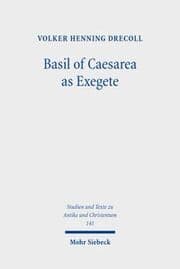
An Analysis of His Homilies on the Hexaemeron, Studien und Texte zu Antike und Christentum / Studies and Texts in Antiquity and Christianity
€89.00
(inklusive MwSt.)
Verfügbarkeit: Besorgungstitel, Festbezug
Zusatztext
Basil's Homilies on the Hexaemeron are one of the most important exegetical works of the 4th c. CE. This monograph contextualizes it into the ongoing exegetical discourse on Gen. 1 in the mid-fourth c. CE, so far neglected in scholarship. This discourse was mainly shaped by attempts to read Gen. 1 as a scientific text about the origin of the cosmos that was of higher authority than other philosophical views. Basil followed this line of interpretation, though he combined the exegetical methods of homilies with those of a commentary. In this, he proved to be remarkably independent of Origen. There is no evidence for the fact that Basil used Origen's Commentary on Genesis , which raises the more general question about the often assumed "Origenism" of Basil. Also, his Homilies on the Psalms cannot be regarded as an "Origenist" work, because allegorical interpretations play a major role in very few of these homilies only. The refutation of allegorical interpretation as displayed in the work is due not to Origen, but presumably to Didymus' exegesis of Gen. 1. By sticking to the text, Basil wanted to lead his audience to admiration of God as the creator. His audience, however, did not appreciate his efforts, to which Basil reacted by intensifying the homiletic purpose of his sermons in the second half of his homilies. While the Homilies on the Hexaemeron remain unfinished, the transmitted two Homilies on the Creation of Human Beings , attributed in some manuscripts to Basil, pretend to complete the explanation of Gen. 1. The question of whether these homilies are authentic or not is tackled anew by comparing this to other works of Basil, such as On baptism or the Explanation of Isaiah . All these works are considered to be not mere fakes, but they go back to unfinished manuscripts left after his death. After his premature death, the theological discourse changed quickly. Already some years later, Gregory of Nyssa made extensive use of Origen, though he felt deeply indebted to his elder brother Basil.
Autorenportrait
Born in 1968; studied theology in Münster; 1996 doctorate; 1998 habilitation; Professor of Church History in Tübingen, with a focus on the Early Church; Ephorus of Evangelisches Stift Tübingen.
Weitere Details
Erschienen: 18.06.2025
Umfang: 277 S.
Sprache: ENG
Einband: KT
Format: 1.6 x 23.3 x 15.5 cm
ISBN/EAN: 9783161640582
Umbreit-Nr.: 4710292
