
Ambivalenzen des Übergangs
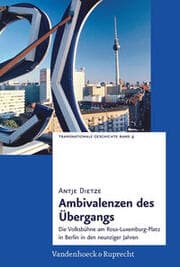
Die Volksbühne am Rosa-Luxemburg-Platz in Berlin in den neunziger Jahren, Transnationale Geschichte, Transnationale Geschichte 4
In der Übergangszeit nach der deutschen Vereinigung hatten Künstler und Kulturinstitutionen große Bedeutung: Sie stellten kulturelle Traditionen auf den Prüfstand und prägten damit den gesellschaftlichen Wandel entscheidend. Die Autorin untersucht dies am Beispiel der Volksbühne in Berlin, die zum kulturellen Erfolgsmodell der 1990er Jahre wurde. Sie zeigt, wie die Volksbühne mit ihrem betont ostdeutschen Profil die gesellschaftlichen Konflikte der Nach-Wendezeit kritisch aufgriff, und beschreibt den Wandel der deutsch-deutschen und transnationalen Beziehungen der Volksbühne vor und nach 1989.
€95.00
(inklusive MwSt.)
Verfügbarkeit: Besorgungstitel, Festbezug
Zusatztext
This volume studies the success achieved by the Volksbühne at the Rosa-Luxemburg-Platz in Berlin through its participating in societal change following the fall of the Berlin Wall and the reunification of the East and West Germany. In the time immediately after the reunification of East and West Germany, artists and artistic institutions played an important role in society: They put cultural traditions to the test and thus put their stamp on subsequent social changes. In this volume the author studies this phenomenon using as an example the Volksbühne Theater in Berlin, which became a model of cultural success in the 1990s. It shows how the Volksbühne critically addressed the social conflicts by emphasizing its East German roots, and it describes the changes that took place in the inner-German and international relations of the Volksbühne both before and after 1989.
Autorenportrait
Dr. Antje Dietze ist Wissenschaftliche Mitarbeiterin am Centre for Area Studies der Universität Leipzig.
Weitere Details
Erschienen: 19.11.2014
Umfang: 412 S.
Sprache: Deutsch
Einband: GEB
Format: 3.3 x 23.9 x 13.6 cm
ISBN/EAN: 9783525301715
Umbreit-Nr.: 7526788
