
Rumanian Folk Music
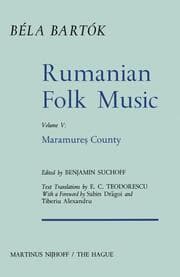
Maramure? County, Bartok Archives Studies in Musicology 5
€53.49
(inklusive MwSt.)
Verfügbarkeit: Besorgungstitel, Festbezug
Zusatztext
he wealth and variety of artistic creations evolved by the Ru T manian people in the course of the centuries have long alerted the interest of foreign scholars whom circumstances brought to the lands of the Rumanians. The Polish chronicler Matthew Stryjcovski (16th century), the Genovese Franco Sivori, secretary of the 16th century reigning prince Petru Cercel, the Magyar poet Balassius (Balassa Balint 16th century), Paul Strassburg, the envoy of Sweden's 17th century King Gustav Adolph, the Silesian poet Martin Opitz (17th century), the German Johannes Troester (17th century), and many others have left us many accounts, often praises, all precious testimonials providing a better knowledge of past times. The first notations of Rumanian popular melodies known to us like wise go back to the 16th and 17th centuries. The tablatures for organ left by the musician Jan of Lublin, by the Franciscan monk John Caioni, who was of Rumanian origin himself, and by Daniel Speer, and, indeed, those recorded in the manuscript known to musicologists as the Codex Vietoris, are not, however, to be considered as true collections of folklore. Nor do the ten "Walachische Tanze und Lieder" collected and published in Western notation by the Austrian Franz Joseph Sulzer, in the second volume of his Geschichte des Transalpinischen Daciens, das ist: der Wala chei, M oldau, und Bassarabiens, printed in Vienna in 1781, come under the heading of a folklore collection as we understand the term today.
Weitere Details
Erschienen: 09.11.2011
Umfang: 329 S.
Sprache: ENG
Einband: KT
ISBN/EAN: 9789401016889
Umbreit-Nr.: 5654202
